SEO is an important component to shape and regulate your brand portrayal in the SERPs.
All forms of marketing play a part in good brand management.
Using the same tone of voice throughout your ads and emails and choosing the same photo assets for your website as your billboards contribute to the picture painted when a customer considers your product or service. Sometimes, however, your brand might be in receipt of some negative press or reviews that can alter the way it is seen.
If a potential customer wants to know if your business is reputable, they will likely search for you online.
Visiting your website isn’t enough; they’ll want more objective feedback.
So, online reputation management, is critical.
It is the process of shaping and controlling the history around your brand online.
SEO is an important step to consider in that process. Reputation management in SEO is all about ensuring that wherever a searcher encounters their brand in the search engine results pages (SERPs), they take away a positive message about it.
This often means ensuring that the brand influences the front page of the SERPs and the articles pushed in Discover feeds, as well as the News results.
Online reputation management (ORM) is critical for SEO because, no matter how good a website ranks, if the perception of its brand is negative, it will struggle to get clicks.
SEO professionals must stay aware of how the brand they are working on is perceived elsewhere on the internet. .If there is negative sentiment about the brand, it is unlikely that a good call to action in a page title will be enough to get a click.
It’s also important to realize that organic traffic that doesn’t convert will not be very valuable.
A brand’s online reputation can have a huge impact on conversions.
Research into a brand, product, or service often begins online with a search.
Your website will likely only be one or two of the results brought up when someone searches for your brand.
All those other search results will potentially say something about your brand that might not be as favorable as you would like.
Unfavorable comparisons between your product and a competitor can be made by an objective third party.
Bad press can be high-ranking.
If you aren’t actively monitoring what appears at the top of the search results for your branded keywords then you could be missing out on the opportunity to spot potential reputation issues.
Once a news story starts circulating about your company, or even incorrect information is added to a third-party website, it can be hard to repair the damage to your brand.
It is important that your brand’s message is what’s seen on the first page of the SERPs. Proactively working on your online reputation management can put you in a strong position to correct misinformation or outrank unfavorable content.
A company’s culture is the foundation upon which its operations are run, hence should be friendly, open and nurturing – to motivate employees through hard times.
After working at an organization for a certain period of time, your tenure eventually comes to end ends, and you meet situations and people demanding you to give an account of your career’s affair at that firm. While this exiting might come either through a retrenchment, a transit to a greener pasture or through retirement, how comfortable you were as an employee at that firm greatly determines the kind of comment you give about it. This situation often gets one telling the truth as at that point you stand to lose nothing if you give a negative comment about the place, just as it is, if they give a good comment. Hence, as more former employees and clients continue to get accustomed to writing reviews about their former workplaces or products, their comments have in turn become a major constituent in what is popularly known as a company’s reputation.
Although clients are also fundamental in defining the quality of a firms reputation, employees who by far are seen as insiders – with more accurate details about the companies’ transactions, are seen as those with the ultimate clue. While these comments tackle areas like the company’s infrastructure, the employer’s relationship with the workers, quality of products and services and to allowances, a workplace can either be described as good or bad, nothing more – and this sets the difference between successful companies and those that are known to be to failures.
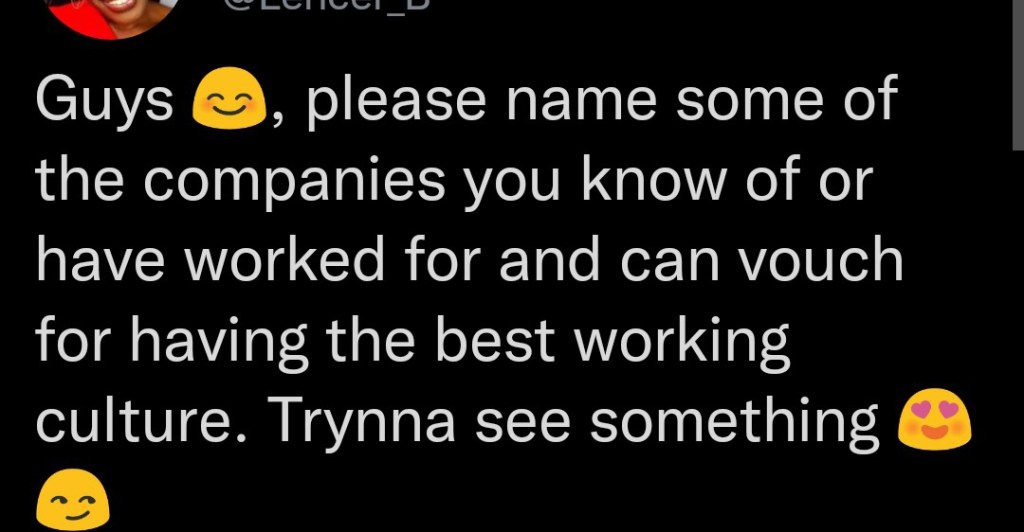
Following a popular tweet that saw some renowned companies faulted over their negligences, by people who during some particular time acted as employees in these firms, it is vivid that the even the countries most prestigious firms have at times missed some steps that greatly sabotaged their reputations. But how well they are able to gather their reputation back into a solid thing, is what says whether they remain at the top or not.
They tweet by this influencer demanded people to tweet back, openly, names of companies they had worked for, or were working for and which had exceeded the expectations in terms of employee satisfaction. For respondents who cited workplaces they were no longer working for, had their responses merited against the degree of their desirability to go back and further their careers as employees there, while those still at work against the level of their desperation if they were to be relocated to other workplaces. The responses were stupefying and the names that appeared there were nothing close to what most anticipated.
In just a few days, the post became very popular and amassed over three thousand likes and comments. The tweets came from diverse sources including from Kenyans who worked with international organizations like the Thompson Reuters and even from those living and working in diaspora. However, aside the much important accolades in form of positive testimonies, that respondents bestowed on their companies, the post became part of a broader debate about the status of the country’s employment scene and generally how well most of the organizations were prioritizing their employee welfare.
Screenshot of the twitter post by Bambi, one of the leading influencers.
A ‘good company’.
To decipher the lessons sent forth by this tweet we can possibly take one of the highly liked tweets which despite its exclusivity in context of it’s message, had much discourses to lend to both employees and their employers. The person who seemingly was from Mwea Tebere area in Kirinyaga, referred to some days when they used to harvest rice at a certain mzees farm, and his selfless nature saw him give them very sumptuous meals when ideally workers were supposed to bring their own food – for the employee to make a profit after paying them their daily wage. The meals which he said were not only sumptuous but in plenty costed him a lot that he would be left with no profits or just a sliver of it. In turn this saw employees flow in and out of his farms when there was scarcity of labor in the area and also came in handy to provide him with labor when he was facing financial hiccups. This influencer despite delving on a very far-fetched context, different from the ideal one of offices, gave an example that ultimately said it all. That it’s very important for to firms pursue a charming character first, then seek to prioritize on amassing profits. It came so easily for this farmer to convince the workers to work for him when he was out of cash, as they were more than sure that he will meet his promise, and even due to the outgoing nature he had showed, them felt very obliged to work for him, even if the guarantee to be paid was not there. Yet while profits remain the core motive upon which enterprises are brought up, they don’t always flow in if the company’s reputation is not withstanding and if employees are not satisfied or happy to be part of the firm’s team. To grasp a good reputation companies should seek to provide a quality experience, give priority to customer service, get involved with its community, respond to reviews, build its online presence, all the time as it focuses on treating its employees well. Employees are very important for reputation building and their extra-role behaviors, such as being positive spoken people for the firm, can improve organizational effectiveness and efficiency which increases the organizational reputation. An organizations reputation is basically its greatest intangible asset. When a company is viewed as reliable, transparent, and responsible it can set your business apart from competitors – offering a tangible advantage in your market.
Role of social media
Unlike the situation we had a few years ago where public foras or group discussions were the popular ways of debating about social problems, social media has come up very first to alter this ideal. Still, way past its motive of being just a social networking site it has redefined its role as a tool upon which organizations can greatly build themselves or dramatically drown to very low levels.
The fact that the tweet allowed people to publicly tag companies both for their goods and bad, it significantly became a changing point for companies that came beneath the ladder, to make an effort and scale up their priorities to enhance their public image. With a good reputation, companies can easily inch closer to their potential customers since there is evidence of trustworthiness and honesty hence reaching out to their goals as these customers are ever ready to even pay more. This defined the new role of social media as a great innovation, very fit for societal development including through acting as a watchdog against manipulative firms that don’t prioritize employee welfare. For example, when more than two negative comments from different individuals landed on a single company citing their unfriendly employee treatment, the rest would reply with besmirch emojis suggesting that they had already built a bad image about the firm and would not even like to do business with them leave alone working there. So far, the purpose of social media which has greatly improved is now very applicable in business to attract customers, get customer feedback and build customer loyalty, increase a firms market reach including international markets, do market research and reduce marketing costs and also to increase revenue by building customer networks and advertising.



 ManagersMag