Multiplatform storytelling to conceive durable workplaces.
Author: Kimathi Ireri
I am Steve Ireri and my writing majors on the musings of a distorting world and the adaptability of humans in society plagued by a radical pursuit for modernity. I am ebullient and hawk eyed to generate striking articles. Let it never be said that our new world was built on the madness of the old.
“My brain is my garden. If I feed it – it will grow; if I nurture it – it will thrive; if it thrives – so will I.” – Jen Chastre.
Many people think the key to being well is focusing on physical wellness – that you need to eat right and exercise to be healthy. While that is true, there are actually multiple factors that affect your overall well-being.
Intellectual Health defines the quality of your mind at a particular time of your life, be it while you are young, during old age, or at any other age. It includes the ability of your brain to change, adapt, learn and grow with time. Intellectual health emphasizes the importance of having regular intellectual activity, taking care of your mental fitness, and practicing life-long learning
Intellectual health is essential for overall good health and life. Diseases like Alzheimer’s and Parkinson’s are the result of changes in brain chemistry and function. Taking care of your intellectual health can keep your brain functioning well for longer. This is also why it’s so important it is to be well-informed about education and intellectual wellness overall
The International Wellness Institute defines wellness as an active process through which people become aware of, and make choices toward, a more successful existence. This aligns with the six dimensions of wellness model, which includes physical, social, emotional, spiritual, occupational, and intellectual wellness. Though unlike with others like spiritual or emotional intellectual wellness mostly concerns with being open to new ideas, thinking critically, and seeking out new learning opportunities and challenges. It’s being creative and promoting mental stimulation, and involves commitment to lifelong learning.
Mostly activities like the learning of a foreign language, reading for fun, working out puzzles such as jigsaws, crosswords, or Sudoku, Playing a board or card game, writing a journal or even playing a musical instrument are very core to keeping someone’s intelligence in good shape. In some other ways, participating in these activities has been shown to stimulate the brain and increase the connections between brain cells. According to the latest findings in Neuroscience, your brain reaches its peak performance at age 16-25 years, and thereafter, cognitive functioning declines. Exercising your mind gives you faster thinking and reaction time, increased focus and concentration, better memory, less stress, sharper vision and hearing, and a more positive mood.
However the activities that involve building someone’s intelligence like working out puzzles or reading books are deemed by far as hobbies hence the negligence by most people who argue that their hobbies are elsewhere. However given the much benefits the habits have on someone’s intellectual Wellness one can’t keep on avoiding them. To clearly gauge that you have greatly began to chart a good path towards intellectual wellness you should be able to a discern a development of good study skills and time management, an ability to challenge yourself to see all sides of an issue or even when you notice yourself becoming a critical thinker.
Others signs that mark good progress with development of intelligence include an advancement of your own ideas, views, and opinions and more appearance of situations where you are exposing yourself to new ideas, people, and beliefs that are different from your own
How To Improve Your Intellectual Health
However because it’s not a walk to develop intelligence through habits that hinge on innate factors like passion here are some ways to improve one’s intellectual health. The listed notes underpin how one can maintain Healthy Levels Of IQ And Intellectual Function.
For example, boosting your Intellectual Health By Learning a new Language, bonding with your family, keeping good track of time and ensuring that your physical health is okay can really come in handy in maintaining healthy levels of IQ and a human being’s intellectual function. Nonetheless, someone who is up to improving their intelligence will more often practice curiosity and will try to engage In discoveries if not proposing to safeguard all the aspects of their health for the entire days they live on earth.
Gen Z Remaking of the workplace through silent revolt.
In a normal setting and context, the office is a place of utmost reverence where jokes and unserious business is highly shunned. It has distinguished itself as a strict structure through it’s set of standards and codes which throughout history have been exercised fully giving the office what is now labeled an official look. Until now the ideal workplace is where employees have a regulated dressing pattern, a strict operating schedule, a summoned technique of behavior alongside other many regulated laws. It has with time become customary and has helped firms yield good results through observance of mannerism and limiting one from acting against the codes. . It is the sole duty of the employee to not only present himself in a decent way but also act modestly to bring up the impression that he is a worker in a certain organisation without the telling it out verbally.. The positive observance of the customary rules by all the outgoing generations has successfully achieved a durable and traditionally-run workplace that through less questioning the involved organizations have been able to trace credible results. Transgressions like lateness, improper dressing and passivity therefore beg for punishments like summons, suspensions or expulsions.
However, with the emergence of gen Z (people born between 1995-2010) – the right age of technology, the ideal workplace that for decades helped companies get the top is bound to transform for good. With all the existing generations having persevered the regulations, this one specifically finds it hard to pull the strings and operate in such authoritarian environs. While research affirms that previous pairs of offspring’s held a decisive anticipation for work, the current gen z feels pessimisti about work, c made wearyt by the unlike work procedure, and given shivers by the fact that their conditioning is weaker upon pressure. Their upbringing has been a concord of pampering which added up to the technological effects has enveloped them in a modest culture of unruliness, laziness and social queerness. For the generation, status is not rewarded for obedience but rather for rebelliousness. And this has added to their in capability to fit in to the present world.
“I find office life hard and I would prefer it to self employment, where I can work with zero supervision and with no regulations”. Says Eddy Mwenda a student at Meru university of science and technology. Eddy 21, a data science practitioner who is in his final year, believes that their parents who grew up with minimal distractions in the social sphere are agreeably fitted for the current rigorous office system. In it, there exists numerous constraints like time, dressing behavioral which have a regulated protocol that bars their creativity and fantasy to fully deliver upon tasks. “ like it or not our programming is exotic, and of all the generations we not comparable to any other”. Adds eddy.
Generation Z which the worlds youngest set of adults, is charting a different approach to work, where they deliver the results but in more self-reliant space. Their call for breaking the stereotypical yokes of the existing workplace being fashioned by natural factors like their growing-up environment, manner and how they were handled it, fully contrast that of the previous generations begging the dire change of the system.
The generation is informally referred to as zoomers and is the demographic cohort succeeding millennials and preceding generation alpha. It is famous for erratic stunts of unruly behaviours, irrational laziness, less worry some about their future and it’s the cohort nicknamed media zombies for their addiction towards tv and social media. Born between 1995/and 2010, the oldest of the generation has already graduated from university and have have already tasted the bitterness of the workplace. Previously, focus on how incoming generations manage the workplace had been on millenials, who seemed unusually underprepared, but now the utmost of it is on the generation Z who for quite some time have shocked the local workplace scene. Their conduct and their pleasure-pursuing reaction, will in many ways reshape the conventional workplace.
How the civilized manner of the Gen Z will reshape the workplace.
a recent Gen Z survey proved how challenging it is for the two generations to navigate work at turbulent and difficult times.
According to Deloitte, its latest global 2022 survey across 46 countries revealed a clear picture of how this generations rede
fine working behaviors and “strive to balance their desire to drive change with the challenges of their everyday lives.”
Aside from financial concerns, the Deloitte survey also revealed that four in 10 Gen Zs and almost a quarter of Millennials like to leave their jobs within two years, and approximately a third would resign without having another job lined up, indicating “significant dissatisfaction levelsI in a trend known as ‘quet quitting th youngsters gradually start retiring without a notification by declining to work slowly until they are out of the door.
The youngsters are all-day vibrant, unrestricted, blissful and are sticklers for the finest things of life. They look for pleasure in every single activity of their life hence developing an indifference towards work which is lesser activating and more of draining. Reports indicate that they burn out quite fast upon work. Their level of commitment towards tasks and their capability to handle pressure is minimal compared to that of millennials, alphas and the previously arisen generations. In a report conducted by Asana, a work, -management platform in 2021, showed that the GenZ showed more signs of burnout easily than all other generations and age groups. It is therefore apparent that while millennials (generation born right before gen z) portrayed lesser endurance to long working hours, gen zers went overboard to wear out faster upon even deficient tasks. It is more upsetting gen zers have reporte the burnout signs mainly at the wee stages of their careers. This aspect of gen zers thereby will alter the 8:00-5:00 working schedule to a more relaxed roster if they have to deliver top+notch work. Although although the Kenyan government has not fully flagged in the four day working schedule, it was intended in the USA in a bid to save the millennials and gen zers from dying at work. “46% of Gen Zs and 45% of millennials feel burned out due to the intensity/demands of their working environments,” the organization said, citing its research. “44% of Gen Zs and 43% of millennials say many people have recently left their organization due to workload pressure.”
Also while surveys present these youngsters as lovers of booze, their management will be difficult, and their allegiance upon pleasures will overtake that of work. The toll of their laxity will rip off an important chunk from the additional prosperity that organizations used to garner from the hard work of previous generations who through their devotion- working extra hours to see the goals are attained, pu their respective organisations at the top To the detriment of the workplace, their alarming quest for pleasure will cost the workplace momentous time for meaningful office work.
Therefore studies place their alcoholism at the center of the workplace suggesting that reternchment will act futile as the numbers will will be huge. With most of generation zers being ardent lovers of enjoyment, alcoholism mentioned in place of other substances is one major problem challenging their concentration to tasks.. Most of them through peer pressure, desire to engage in unruly vices and rebelliousness begin the habits in high school and college and right when their career begins the majority are in an addiction crisis which they have to relive by either drinking at work or taking a day off. Although some employees in the prevailing employment scene are alcoholics the high number of college and high school alcoholics suggest that the number will definitely surge by the time the workplace is fully flocked by generation Z. Unlike previous generations, gen zers commence their drinking career in high schools largely and partly in primary schools. By the time they get to college, the bondage of an addiction has easily slipped into their lives unlike other generations who start drunkenness later in their lives.
Asides all other troubles, breaking of the customary office dressing code the ‘official wear’ will be first to be discontinued. Generation zers confidently believe in some dressing codes like suits to being archaic and not adding up to their favorable levels in dressing. While ancient suits pertained extremely baggy trousers, prospective generations reduced the sizes to skinny pants. So far current standards emphasize slimmed pants raised a level over the ankle donned with a tight shirt and a bow tie. Some of generation zers have seemed to like this code while others still perceive it as outmoded, and levels in This modification can be explained clearly by the example of the luxurious sneakers
Scotland is the worlds leading country with best hospitality services, beating other countries like the United states whose number of lavish hotels and inns is bigger and more refined. This clearly tells you that hospitality does not depend so much on how lavish or modernized the firm is but rather how reasonable and composed the clientele is. While hospitality demands a lot of concentration on things like etiquette, most countries just like most individuals here in the country assume it’s a small thing – contributing to the lag in Kenya’s hospitality achievement. Although the majority of African countries grapple with this area, foreign countries like the united states as well struggle to achieve the full range degree of hospitality. In Scotland however, the people practice it firsthand and the Scottish culture since the colonial era, revolves around being courteous hence their enviable triumph. The countries’ people’s natural command of discipline and etiquette has significantly translated to its success, producing very popular figures like Alex Ferguson who later on became the most successful British football manager.
While Ferguson was leaving the football career as a longstanding manager, he asserted that many things had contributed to his success but etiquette he said saw to it that he remained at the top. Alex who started his career at the age of 16 as a mere footballer worked hard like many other budding footballers but his extraordinary sense of discipline, brought him this coveted niche the majority of footballers never got to. The countries codes of parenthood which apply even in their schools strictly emphasizes that children learn the tricks of having a good command of etiquette not mainly for the sake of their prosperity but for their own good and satisfaction.
Listening.
Being able to listen to someone not just for the sake of hearing because you have to but for the sake of trying to help, is one of the top-tier virtues that have made Scotland a hospitality powerhouse. Whenever someone loses their way, he wouldn’t feel afraid to ask any person for directions as people aren’t used to misleading others or responding in harsh words. This should be the point to benchmark as the case in most African countries is very different. biggest problem that prevents this bit of hospitality from succeeding in the country is crime. Employees who fashion their rude demeanor always keeps guests away and locks the firm from making a step forward. Employees in the sector should at least learn how to listen actively which helps one build rapport and confidence with client’s.
Oral communication.
The prowess of most Kenyans in the hospitality industry is put into test in occasions when they face clients who can only speak foreign languages. Both written and spoken communication is very crucial in the process of charting a proficient hospitality business. Scotland has successfully achieved in this spectrum as most of its residents can speak more than five foreign languages leave alone the employees in the hospitality industry. The country in general boasts a language diversity of over 170 dialects which due to the welcoming nature of the people have been experimented with and can be spoken efficiently. Using body language and showing willingness to speak as they ensure their eyes are directly poked on the other persons eyes are some of the communication tricks that have up to date kept them at the peak.
Customer orientation.
Employees in a hotel or organization structures its image through their dealings with the hotels clients who mainly after their stay, will sit down and write a rating comment. This goes a long way in determining whether the firm makes progress or doesn’t. How they carry themselves and how they talk greatly infers the reviews your firm gets and whether that celebrity you hosted will want to book your hotel once again. It is therefore the duty of the employees to ensure they do everything that is within their power to see to it that customers are pleased. Great hospitality employees have a natural longing to please others, regardless of the time or day it is. They encounter fulfillment in making sure their guests have everything they need.
Stress tolerance.
Employees in the hospitality industry ought to have the resilience to withstand rude, impatient and unresponsive customers, as well as the rigors of working long shifts, often on their feet, and at the moment, probably in an understaffed establishment. When AA hospitality awards crowned several of Scottish restaurants for their exceptionality in the hospitality industry its obvious they were attracted by the talents of the hotels employees to maintain cool heads even after encountering several heated situations. Employees should be able to defuse a troublesome situation and remain calm and composed while they do it.
Quality orientation.
“I think Scottish people are driven by what we can do better, we’re driven by a pride in producing products of a very, very high caliber and it’s not just about what happened in the past and the heritage, it’s about what we are doing now and how we can do it better “says mark Hogarth the creative director of Harris tweed Hebrides a luxury fashion brand. Mark is at the forefront of the blossoming textile business in the country and opines that although in most occasion designers are compelled by their desire for profits, quality should always be a necessity with or without the profits. According to Mark, production of quality goods and services never ends in bad way as people will always prefer your services or products if you pledge to stick to quality.
Creativity.
Staff should be able to think fast and in a unique way until they catch the attention of their clients for the same if their employers. Creativity from employees is what in most cases places a certain hotel at the very top of the market as the management can think out of the box and offer something that the clients have never experienced elsewhere.
Posted on
IN HOSPITALITY SCOTLAND IS KING, HERE IS WHAT TO LEARN FROM THEIR AWARD-WINNING HOSPITALITY INDUSTRY.
Scotland is the worlds leading country with best hospitality services, beating other countries like the United states whose number of lavish hotels and inns is bigger and more refined. This clearly tells you that hospitality does not depend so much on how lavish or modernized the firm is but rather how reasonable and composed the clientele is. While hospitality demands a lot of concentration on things like etiquette, most countries just like most individuals here in the country assume it’s a small thing – contributing to the lag in Kenya’s hospitality achievement. Although the majority of African countries grapple with this area, foreign countries like the united states as well struggle to achieve the full range degree of hospitality. In Scotland however, the people practice it firsthand and the Scottish culture since the colonial era, revolves around being courteous hence their enviable triumph. The countries’ people’s natural command of discipline and etiquette has significantly translated to its success, producing very popular figures like Alex Ferguson who later on became the most successful British football manager.
While Ferguson was leaving the football career as a longstanding manager, he asserted that many things had contributed to his success but etiquette he said saw to it that he remained at the top. Alex who started his career at the age of 16 as a mere footballer worked hard like many other budding footballers but his extraordinary sense of discipline, brought him this coveted niche the majority of footballers never got to. The countries codes of parenthood which apply even in their schools strictly emphasizes that children learn the tricks of having a good command of etiquette not mainly for the sake of their prosperity but for their own good and satisfaction.
Listening.
Being able to listen to someone not just for the sake of hearing because you have to but for the sake of trying to help, is one of the top-tier virtues that have made Scotland a hospitality powerhouse. Whenever someone loses their way, he wouldn’t feel afraid to ask any person for directions as people aren’t used to misleading others or responding in harsh words. This should be the point to benchmark as the case in most African countries is very different. biggest problem that prevents this bit of hospitality from succeeding in the country is crime. Employees who fashion their rude demeanor always keeps guests away and locks the firm from making a step forward. Employees in the sector should at least learn how to listen actively which helps one build rapport and confidence with client’s.
Oral communication.
The prowess of most Kenyans in the hospitality industry is put into test in occasions when they face clients who can only speak foreign languages. Both written and spoken communication is very crucial in the process of charting a proficient hospitality business. Scotland has successfully achieved in this spectrum as most of its residents can speak more than five foreign languages leave alone the employees in the hospitality industry. The country in general boasts a language diversity of over 170 dialects which due to the welcoming nature of the people have been experimented with and can be spoken efficiently. Using body language and showing willingness to speak as they ensure their eyes are directly poked on the other persons eyes are some of the communication tricks that have up to date kept them at the peak.
Customer orientation.
Employees in a hotel or organization structures its image through their dealings with the hotels clients who mainly after their stay, will sit down and write a rating comment. This goes a long way in determining whether the firm makes progress or doesn’t. How they carry themselves and how they talk greatly infers the reviews your firm gets and whether that celebrity you hosted will want to book your hotel once again. It is therefore the duty of the employees to ensure they do everything that is within their power to see to it that customers are pleased. Great hospitality employees have a natural longing to please others, regardless of the time or day it is. They encounter fulfillment in making sure their guests have everything they need.
Stress tolerance.
Employees in the hospitality industry ought to have the resilience to withstand rude, impatient and unresponsive customers, as well as the rigors of working long shifts, often on their feet, and at the moment, probably in an understaffed establishment. When AA hospitality awards crowned several of Scottish restaurants for their exceptionality in the hospitality industry its obvious they were attracted by the talents of the hotels employees to maintain cool heads even after encountering several heated situations. Employees should be able to defuse a troublesome situation and remain calm and composed while they do it.
Quality orientation.
“I think Scottish people are driven by what we can do better, we’re driven by a pride in producing products of a very, very high caliber and it’s not just about what happened in the past and the heritage, it’s about what we are doing now and how we can do it better “says mark Hogarth the creative director of Harris tweed Hebrides a luxury fashion brand. Mark is at the forefront of the blossoming textile business in the country and opines that although in most occasion designers are compelled by their desire for profits, quality should always be a necessity with or without the profits. According to Mark, production of quality goods and services never ends in bad way as people will always prefer your services or products if you pledge to stick to quality.
Creativity.
Staff should be able to think fast and in a unique way until they catch the attention of their clients for the same if their employers. Creativity from employees is what in most cases places a certain hotel at the very top of the market as the management can think out of the box and offer something that the clients have never experienced elsewhere.
At a close spectrum, the role of women in law enforcement is under-looked given the daunting context of the assignments. Particularly men are on many occasions the cherished workers while women are discerned as their support personnel in law enforcement jobs. Although some women have went overboard to beat their male counterparts along their line of duty, their substantial function in the duty is shadowy and not easily distinguishable. In the past, the army was merely a reserve for men while women were trusted to handle other menial jobs that were less pendant on courage and body stamina.
This beges the question; Could there exist an advantage that the gender surpasses it’s male countdimension. “Yes, it does – absolutely,” said Major General Jami C. Shawley at the Africa region symposium on women in security. He asserts that women have an advantage in the enforcement of the law through their natural reconciliation feats, hence very pivotal in peace keeping and security.
In the previous years however, the number of women willing to undertake law enforcement and counterterrorism security has rose significantly prompting the United States departments of justice and state to make a move to facilitate the women into greater succession.
In the regional symposium that commenced June 27 2022 ending on the 1st of June, the U.S department of justice, the U.S department of state and the government of Kenya joined forces to explore their essence of women in security. The gathering, attended by approximately 70 security and law enforcement professionals from eight nations around the African continent, discussed more on enhancing regional and strategic objectives in empowering women as important, essential contributors to security, law enforcement, and counterterrorism.
Now with the weeks long forum women will significantly get a facelift in this line of work and get to understand agreeably, their distinct role in the realm. The symposium that brought together women leaders from 8 African countries, intended to provide a forum for African women in law enforcement lines of work, to undertake career development training, reinforce the growth of women in law enforcement while facilitating counterterrorism efforts.
“The Engaging Multinational Policewomen on Equality and Rights (EMPoWER) program represents the very best of the Department of Justice’s International Criminal Investigative Training Assistance Program (ICITAP)’s commitment to increasing women’s participation and leadership in law enforcement, which bolsters operational effectiveness, expands police institutions’ abilities to engage local communities, broadens the perspective of operating environments, and strengthens police response to crime,” said ICITAP Director Greg Ducot.
The summit exemplified a dire need for the support of more women to embark on the career. Previously while most women in the sector were hurdled in the offices mostly to handle paperworks, the forum’s presenter A.Army Major General Jami C. Shawley, clarified that women had an advantage in peace and security and given their enhancement they would help African nations in curbing terrorism and suitably executing the law.
Through the EmPOwer program the forum builds the capacity of women to combat terrorism by supporting them through leadership opportunities and inclusion in counterterrorism efforts. After successfully conducting the symposium in Croatia the ATA through the US embassy Nairobi Kenya, the US department of justice and the other bodies, amassed the country to garner more from professional women law enforcers.
The ATA program is the U.S. government’s exclusive counterterrorism training and equipment provider for foreign law enforcement agencies. As mandated by U.S. Congress, ATA should promote three policies has three foreign policy objectives: to build counterterrorism capacity of partner countries; to enhance bilateral relationships; and to increase respect for human rights.
The existence of good bonds between employees creates a comfortable niche for workers an organization as they find it more satisfying to work together as a family. In the case where such bonds are nonexistent, employees lose focus and concentration as their minds are always clouded with unnecessary tensions and stress.
Every individual at the workplace shares a certain relationship with his fellow workers. Human beings are not machines who can start working just at the push of a mere button. They need people to talk to, discuss ideas with each other and share their happiness and sorrows. Mostly this is close to what is called human bonding, a process of development involving a close interpersonal relationship between two or more people. However, while human bonding concerns more with filial ties like between family members or friends, it can also develop among groups, including sporting teams and workmates more because these people spend quite a huge period of time together. Bonding is a mutual, interactive process, and is different from simple liking as its the process of nurturing social connection. In a human workplace it’s very key.
Because an individual cannot work on his own, they will always need people to be around to assist in tasks or even to chat with to speak up on some disturbing issue. If an organization is all empty, it is obvious that employees will not feel like sitting there and working. This emanates from the concept that isolated environments do demotivate people and even go further to spread negativity around them. That is why it’s very necessary that people become extremely comfortable with each other and work together as a single unit towards a common goal.
Bonds especially those between blood-tied people like family members is characterized by emotions such as affection and trust. However even with employees who over a long period of time sit alongside each other in the office, the likelihood is that their bond grows to something big relatable to that of family members. Shared activities also compel them to forming a personal relationship which in turn confers the workplace with a ‘family feel’ culture who’s usefulness include more satisfied staff, improved productivity and retention levels and better workplace accord and dynamics. Ultimately whether employees in an organizations ever gets to choose to embrace such a culture is entirely dependent on the decisions of their workplace as well as on its organizational goals.
However employee bonding is not something to surmise, as it can help coworkers learn more about each other and facilitate a more open work environment. That’s why it’s so important for teams to find ways to bond with one another. Understanding the ways employee bonding keeps your team communicating effectively, can help you determine the best ways to build stronger connections.
Employee bonding is particularly about that moment when coworkers connect, grow their relationships and become better collaborators in the workplace. Often its policies can lead to happier and more productive employees, which is important to creating a positive work culture and strong, effective teams. Employers, managers or supervisors can schedule opportunities for employee bonding for whole departments or organizations, but team members can also plan employee bonding events for small groups and teams, too. According to a CIPD survey, over half of employees want a workplace culture with a ‘family feel’. Yet despite this, just over a quarter describe their current workplace as such. This is because employees must coworkers get to know each other better possibly through ways like learning more about your coworkers’ work styles, personalities and personal interests so as to collaborate and work together better.
When such familial scenes are allowed to breed within offices, they improve team performance as workmates can relate in different ways including through understanding and respecting each other’s strengths, weaknesses and interests, which can help you all delegate and complete your work more efficiently. Also unlike when someone is on their own, team’s are more suitable to celebrate a workers achievements which greatly boosts an employee morale by enabling them to feel more satisfied with their workplace.
Through building bonds, workers are more inclined to not only maintain a focus in their line of work but to also think creatively by thinking innovatively. group brainstorming sessions as an example of how bonding stimulates innovative thinking can be wielded in the office, easily in occasions like conference room conventions.
Bonding in remote working
Companies with remote workers should find ways to have these kinds of meetings. There are many ways coworkers can get to know each other on a deeper level while at work, after the workday ends or in another professional setting. Team-building games, Team lunches, Personable meetings, Regular acknowledgments, Game tournaments, Charity events, After-work meetups
Team building and employee bonding may look different when working from home, but it is still possible and useful for employees. Ways through which remote working employees can pull up this very important bonding thing, entail Video conferences, Coffee talks, Team meals and Water cooler chatroom. However, video conferences are the more richer form of bonding than all the others as people can talk on video conferences and their peers can see their nonverbal cues such as posture, facial expressions and physical gestures. Video conferencing may help employees communicate better since nonverbal communication can improve the way people relate, engage and establish meaningful connections with one another. Holding regular meetings via video conference helps team members feel connected while brainstorming, making decisions and providing progress updates.
On June 2021, Terry Gatugi 20, (not her real name) left the Kenya Institute of mass communication to pursue pleasure from a love trip in Mombasa. At this moment of her two weeks trip, school was ongoing but she was not intimidated. Her esteem had vanished when her brother in one of the countries premier media stations promised to connect her to a job. And her passion to toil in the mastery of skills was killed, so the promised chance waits upon a Terry with no skills.
As she confidently advanced out of the azure gates leading to the countries premier media institution, her final utterances would thereby alert me of a trend in the job sector where incompetent folks like Terry, reign. For her, the precondition that you must have certain skills to earn a job have been replaced by family linkage, which those who don’t have are left to tarmac searching for jobs.
It has never dawned on her that taking her studies seriously, would ever be rewarding. She firmly believes that university education is meaningless if one has no connections to the job sector.
Despite the solid facts that sacrifice and patience are the major beginnings in finding a job, connections have affected the validation of that adage. The Kenyan employment sector once a niche for only eligible employees, is devoured by the rise of incompetent folks hired through what is commonly known as connections.
Prominent organizations in the country have turned into safe havens for incompetent people to not only thrive but reap a living. The passion from a relationship easily confuses the managers decisions as the make their recruitment. As a slight misstep, the consequences cause collapse of some very promising enterprises in the country.
They introduce uncouth habits that slowly consume the organization. On their personal life, you find they are the type of workers who flaunt their job on social media- aiming at announcing their new reputation. In the office, they loiter sightlessly, easily engage other employees in gossips and are always up to date with transformations in the office. Players in the game are also blinded by the dismay of watching their allies struggle with the brutal process of job seeking and result falling prey to their feelings. Hence wield their chances to convey relief.
Although students at this premier media school work zealously to remain at the top, likes of Terry are wholly nonchalant. But not disturbed by what her response will be when called to deliver a task, she will join a procession of folks in a lot other organizations in the country, who’s nonexistent skills, were not the hiring factors in their absorption into the job.
the disgrace that that arise due to intake of incompetent workers encourages hiideous way that affect the workplace.
In the majority of bureaus the practice has growed and has become sort of acceptable.
The trend is also touching on the objectives of the organizations through family love conventions in some cases where over four relatives unite in one workplace. In a rare case reported in one of the countries premier organizations, a manager engulfed in family passion had over a certain period in time of agreement , hired workers of the same tribe- his deputy, senior workers and junior workers and even to security guards. At the final days of the organization’s deterioration, it was learnt that the majority workers were unskilled and had been hired for their close relations with the senior workers.
It’s participation in weakening a workplace
For some mistaken facts, family ties are believed to have the most affection. Built on firm poles like having shared a big part of life with him or her, it can be sickening to watch a brother or a sister get desperate with search for work while you bask in a comfy office seat. For the sake of the individuals sentiments, family is family .and the workplace should not change that..
But as the family passion is made unrealistic by the fact that one shouldn’t accept employees based on relationships, the workplace too becomes unrealistic once employees are obtained based on relationships. If the passion is avoided, the workplace survives and thrives. But if it’s retained it submits it the organization for failure and inconveniences. The connected fellow is not beneficial to the workplace as they don’t have skills needed to improve the workplace. They receive payments for minimal contributions and proceed to bring downfalls as a result of unfinished dealings in their transmissions.
Given that they don’t have skills needed, their biggest task in the office is scheming fraudulent measures to hide their incompetence. Upon being given tasks they either deliver crappy work or get it done by other people. Their wo is mostly one that is submitted days after the deadline yet accompanied by a thousand excuses to justify their void.
In their pursue to not be marked as pathetic, they engage in hideous habits as their survival stunts. When this creepy occurrence allegedly fates the workplace a decline is recorded.
Some time this year the institute which is so strict upon students mannerism learnt about her absenteeism and expelled her.
A company’s culture is the foundation upon which its operations are run, hence should be friendly, open and nurturing – to motivate employees through hard times.
After working at an organization for a certain period of time, your tenure eventually comes to end ends, and you meet situations and people demanding you to give an account of your career’s affair at that firm. While this exiting might come either through a retrenchment, a transit to a greener pasture or through retirement, how comfortable you were as an employee at that firm greatly determines the kind of comment you give about it. This situation often gets one telling the truth as at that point you stand to lose nothing if you give a negative comment about the place, just as it is, if they give a good comment. Hence, as more former employees and clients continue to get accustomed to writing reviews about their former workplaces or products, their comments have in turn become a major constituent in what is popularly known as a company’s reputation.
Although clients are also fundamental in defining the quality of a firms reputation, employees who by far are seen as insiders – with more accurate details about the companies’ transactions, are seen as those with the ultimate clue. While these comments tackle areas like the company’s infrastructure, the employer’s relationship with the workers, quality of products and services and to allowances, a workplace can either be described as good or bad, nothing more – and this sets the difference between successful companies and those that are known to be to failures.
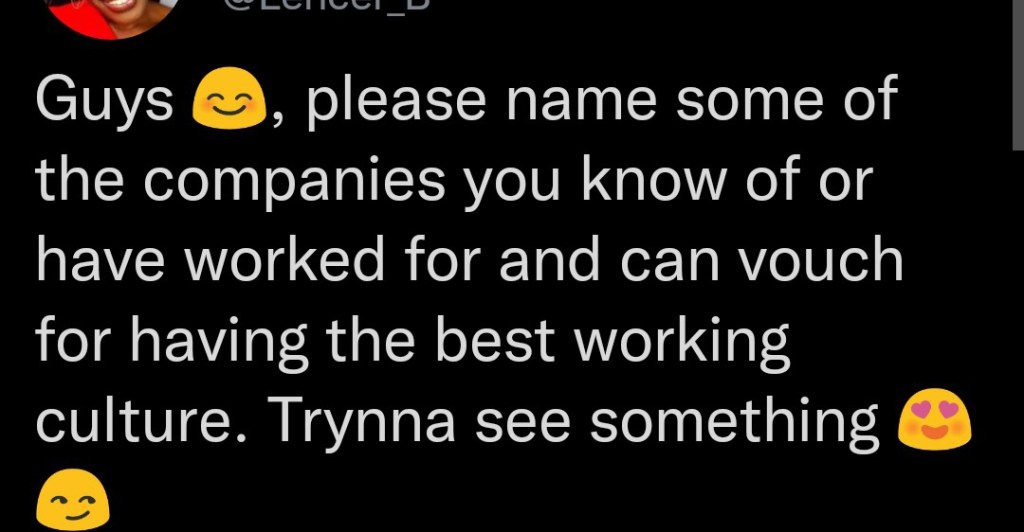
Following a popular tweet that saw some renowned companies faulted over their negligences, by people who during some particular time acted as employees in these firms, it is vivid that the even the countries most prestigious firms have at times missed some steps that greatly sabotaged their reputations. But how well they are able to gather their reputation back into a solid thing, is what says whether they remain at the top or not.
They tweet by this influencer demanded people to tweet back, openly, names of companies they had worked for, or were working for and which had exceeded the expectations in terms of employee satisfaction. For respondents who cited workplaces they were no longer working for, had their responses merited against the degree of their desirability to go back and further their careers as employees there, while those still at work against the level of their desperation if they were to be relocated to other workplaces. The responses were stupefying and the names that appeared there were nothing close to what most anticipated.
In just a few days, the post became very popular and amassed over three thousand likes and comments. The tweets came from diverse sources including from Kenyans who worked with international organizations like the Thompson Reuters and even from those living and working in diaspora. However, aside the much important accolades in form of positive testimonies, that respondents bestowed on their companies, the post became part of a broader debate about the status of the country’s employment scene and generally how well most of the organizations were prioritizing their employee welfare.
Screenshot of the twitter post by Bambi, one of the leading influencers.
A ‘good company’.
To decipher the lessons sent forth by this tweet we can possibly take one of the highly liked tweets which despite its exclusivity in context of it’s message, had much discourses to lend to both employees and their employers. The person who seemingly was from Mwea Tebere area in Kirinyaga, referred to some days when they used to harvest rice at a certain mzees farm, and his selfless nature saw him give them very sumptuous meals when ideally workers were supposed to bring their own food – for the employee to make a profit after paying them their daily wage. The meals which he said were not only sumptuous but in plenty costed him a lot that he would be left with no profits or just a sliver of it. In turn this saw employees flow in and out of his farms when there was scarcity of labor in the area and also came in handy to provide him with labor when he was facing financial hiccups. This influencer despite delving on a very far-fetched context, different from the ideal one of offices, gave an example that ultimately said it all. That it’s very important for to firms pursue a charming character first, then seek to prioritize on amassing profits. It came so easily for this farmer to convince the workers to work for him when he was out of cash, as they were more than sure that he will meet his promise, and even due to the outgoing nature he had showed, them felt very obliged to work for him, even if the guarantee to be paid was not there. Yet while profits remain the core motive upon which enterprises are brought up, they don’t always flow in if the company’s reputation is not withstanding and if employees are not satisfied or happy to be part of the firm’s team. To grasp a good reputation companies should seek to provide a quality experience, give priority to customer service, get involved with its community, respond to reviews, build its online presence, all the time as it focuses on treating its employees well. Employees are very important for reputation building and their extra-role behaviors, such as being positive spoken people for the firm, can improve organizational effectiveness and efficiency which increases the organizational reputation. An organizations reputation is basically its greatest intangible asset. When a company is viewed as reliable, transparent, and responsible it can set your business apart from competitors – offering a tangible advantage in your market.
Role of social media
Unlike the situation we had a few years ago where public foras or group discussions were the popular ways of debating about social problems, social media has come up very first to alter this ideal. Still, way past its motive of being just a social networking site it has redefined its role as a tool upon which organizations can greatly build themselves or dramatically drown to very low levels.
The fact that the tweet allowed people to publicly tag companies both for their goods and bad, it significantly became a changing point for companies that came beneath the ladder, to make an effort and scale up their priorities to enhance their public image. With a good reputation, companies can easily inch closer to their potential customers since there is evidence of trustworthiness and honesty hence reaching out to their goals as these customers are ever ready to even pay more. This defined the new role of social media as a great innovation, very fit for societal development including through acting as a watchdog against manipulative firms that don’t prioritize employee welfare. For example, when more than two negative comments from different individuals landed on a single company citing their unfriendly employee treatment, the rest would reply with besmirch emojis suggesting that they had already built a bad image about the firm and would not even like to do business with them leave alone working there. So far, the purpose of social media which has greatly improved is now very applicable in business to attract customers, get customer feedback and build customer loyalty, increase a firms market reach including international markets, do market research and reduce marketing costs and also to increase revenue by building customer networks and advertising.













 ManagersMag